
Sam Hallas' Website
Click the images for bigger versions. Esc or click X to return.
A more detailed explanation can be found on Wikipedia.

Blandford House

TOPS Terminal
Total Operations Processing System (TOPS) was a computer system for controlling railway rolling stock and movements. It had been developed originally by the Southern Pacific Railroad (US) in the early 1960s. Its success in improving railway management led it to be sold to other railroads such as Canadian National.
British Rail bought the system in the early 1970s. A central control office with computers was located at Blandford House, known as the 'Communications Data Control' (CDC) centre at Marylebone. It was linked to a vast network of data circuits which used modems connected over BR's extensive cable network to all freight depots.
Although TOPS has now been superseded by more modern systems based on internet-like structures, there is still academic interest in it. You may find this article informative, 'The convergence of computing and telecommunications: Cold War to coal trains by Jonathan Aylen & Robert Gwynne.
Blandford House was round the corner from Melbury House where I worked when I first joined the BR Headquarters Telecomm team. Both have since been demolished.
[Blandford House image screen grab from video, Datapoint 2200 courtesy of Joe Oberhhauser.]
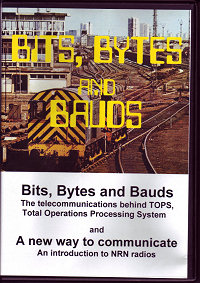
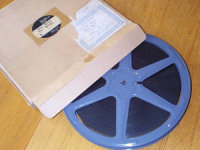
The film 'Bits, Byte and Bauds' was commissioned from British Transport Films, by the British Railways Board Signal and Telecommunications Department in consortium with all the manufacturers of equipment used on the system and was released in 1974. As a result, many of the functions of TOPS are glossed over in the film which only shows its application to wagon load freight. The major focus is on the telecommunications network and the equipment used within it. The custody of British Transport Films has passed to the British Film Institute who have gradually released films on video for public sale. 'Bits Bytes and Bauds' is probably of little commercial interest and unlikely ever to see the light of day.
Fortunately this print of the film was discovered in a railway office in Reading as it was being cleared. So this edition has been digitised privately for DVD by the National Motor Museum Film & Video Service. It will be of particular interest to those who were involved in TOPS.
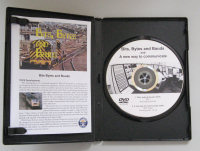
A professional-looking DVD was prepared in 2008 which also included the video, 'A new way to communicate' made as a training film for users of the National Radio Network handportable radios. Also on the DVD for computer users were a number of files with more information on the hardware and various pictures collected during the preparation of the disc. The initial run of 50 sold out fairly quickly.
This was a non-profit venture and the surplus money was donated to the Railway Children charity. Because of the unexpectedly high demand, the amount raised was £110 and I sent a cheque for that amount in early February 2009.
Kaye Brindle at the Railway Children wrote to say, "Thank you so much for your very generous donation of £110 being the profits from your video sales..... With your help Railway Children were able to help 25,571 children worldwide last year."
There were some subsequent sales during 2009, 2010 and 2011 and I have sent further donations as each order was received.
I have made the video files and still pictures available on my Google photos pages. Annoyingly, Google Photos reduces the definition of the video files. If you want the full size use the direct links below.
A booklet on TOPS and an article about hardware and a handbook for the TOPS Terminal can be dowloaded here:


Booklet Hardware booklet User Guide
Devised by Southern Pacific Railroad in the US, TOPS was adopted by British Rail in the 1970s to improve the efficiency of its rolling stock fleet.
The film starts with a brief outline of how TOPS is used to control freight movements and this is followed by a detailed exposition of the hardware and telecomms behind the system.
If you download the videos I should be grateful if you would also make a donation online to the Railway Children charity.
If you have a browser that supports HTML5, then you can watch it by clicking the play symbol. Otherwise, download the file with a right click.
NRN, the National Radio Network was introduced by British Rail in the 1980s to aid trackside and driver to shore communications. The film starts with dramatisation of how the system can be used by rail staff on the trackside. This leads on to a guide to the use of the handportable radios applied to the scenario seen at the beginning.
AS before, if you have a browser that supports HTML5, then you can watch it by clicking the play symbol. Otherwise, download the file with a right click.
Photos & text, © 2008/2009 Sam Hallas/ Andrew Jones. Updated with direct links 2016, Lightbox larger views, TOPS section 2026, general tidy up, SMH