
Sam Hallas' Website
Click the images for a larger version. Click 'Close' or press ESC to return.
So far the systems examined are what we would call transitory. If a character is missed there is no way of getting it, back. Though, for ordinary text, the missing letters can often be guessed. Another problem is that these systems need constant attention from an operator. A far better scheme is to produce a permanent record. There is much less chance of a mistake, and any queries can be checked later.
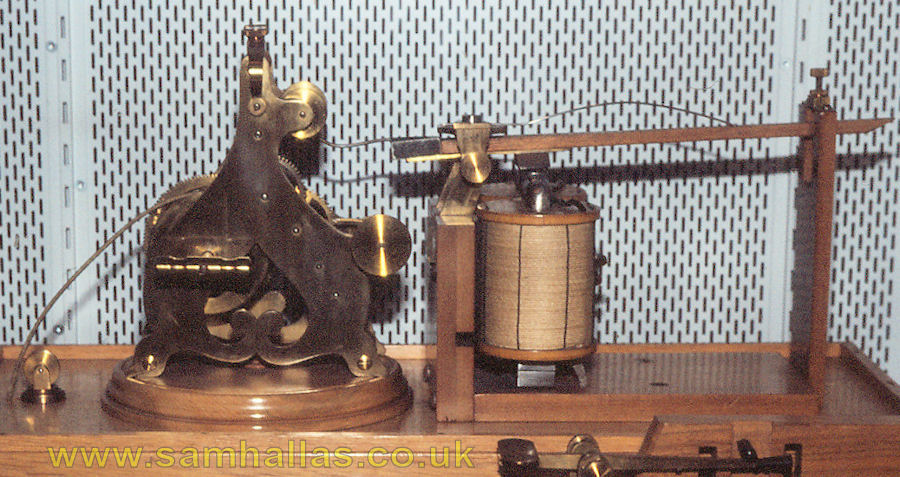
Morse embosser
One of the earliest attempts at this was the Morse embosser. It was invented by Sam Morse in 1837, but was first used in 1844 over the 40 miles from Baltimore to Washington.
At first an automatic sender was used consisting of a plate with long and short metal bars for the Morse equivalent of the alphabet and numbers. The operator slid a pointer across the bars. The pointer was connected to a battery and to the line. And so dots and dashes were sent to line.
Competent telegraph operators soon memorised the code, so all that was needed to send the signals was the simple Morse key which we are all now familiar with.
The receiver had an electromagnet with a stylus on the end of an arm. When the magnet operated, the stylus produced a dent in a paper tape wound past by a clockwork motor. But the dents in the paper were often faint.
Fons Vanden Berghen demonsrates an early Swiss embosser
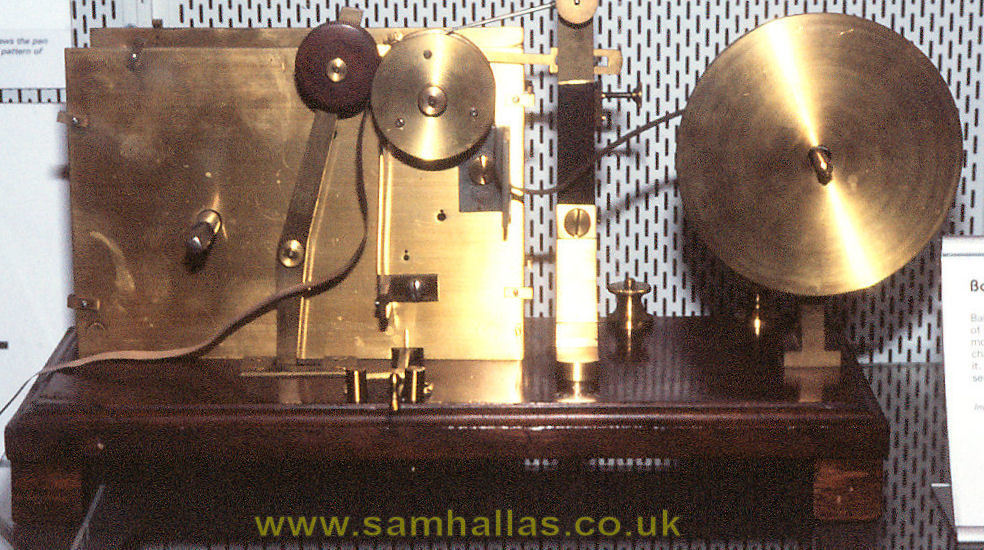
Bains chemical telegraph
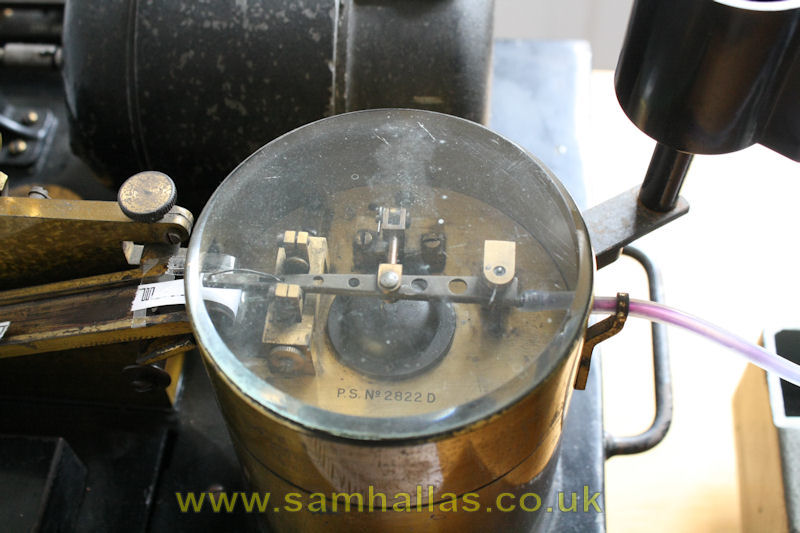
Undulator at Bletchley Park
In 1845 the embosser was replaced by the Bains chemical recorder, and again in 1854 by the Morse inker, invented by Thomas John of Vienna. Here an inked wheel in contact with the paper tape produced easily readable characters.
Later still the undulator was invented which deflected a fine stream of ink onto a moving paper tape. This type of receiver was very sensitive enabling it to be used on long cable circuits. Examples were in use at Bletchley Park where the German ciphers were broken during WWII
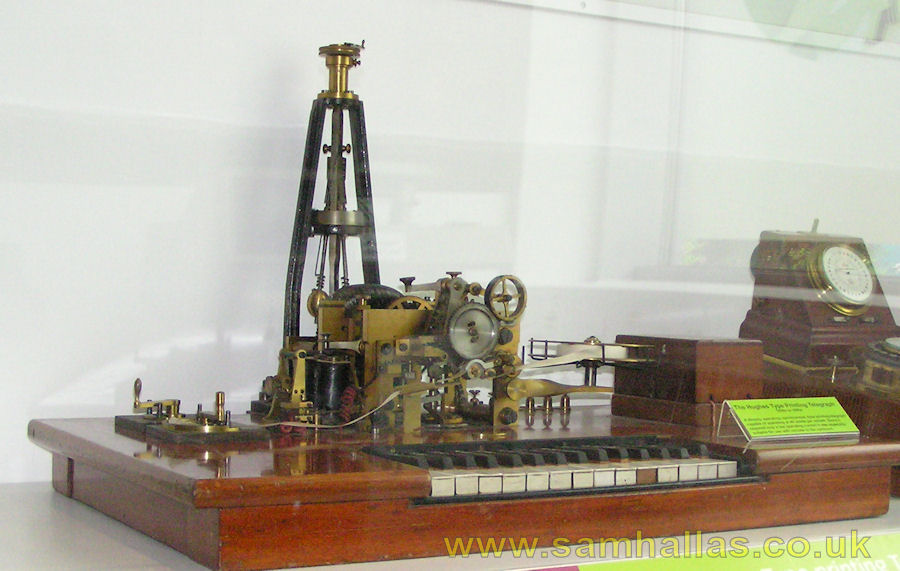
Hughes printing telegraph
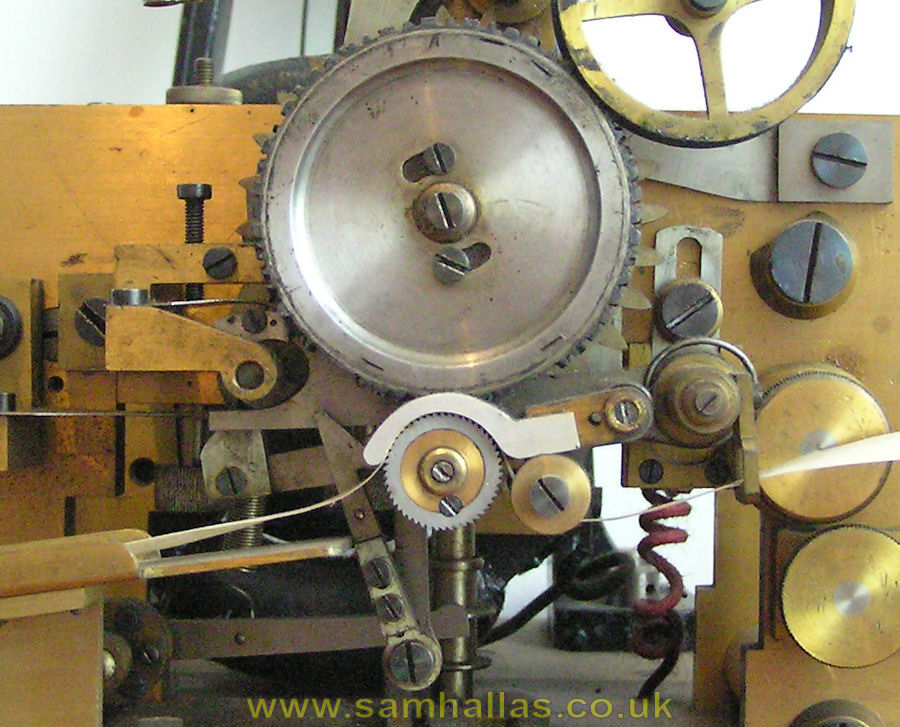
Hughes printhead
The advantages of a telegraph that printed characters directly was obvious from a very early date. In fact attempts were recorded as early as 1832. The Hughes printing telegraph was invented by David E Hughes of Kentucky in 1855. Like the earlier Brett system, the transmitter used a piano type keyboard with 28 keys. Each key has a letter or numeral marked on it. The typewheel went round continuously carrying 56 type pads for letters of the alphabet alternating with figures and punctuation marks. The change from letters to figures and back was done by sending special ‘shift’ signals.
The transmitter and receiver ran in synchronism. Each character was sent by a single pulse of current, the same for all characters, but separated from the last by a different time period, depending on how long it took for the type wheel to reach the next character - what we might call today ‘pulse position modulation’. A good operator could send up to 30 words a minute.
The Hughes system was very stable and accurate. The cable companies got good mileage out of it, literally, on submarine cable circuits between Britain and Europe. But it needed considerable skill to work. Unlike the Wheatstone ABC, it had to be operated rhythmically - in time with the print wheel. Inland it was mostly used for coded messages, where its accuracy was important.
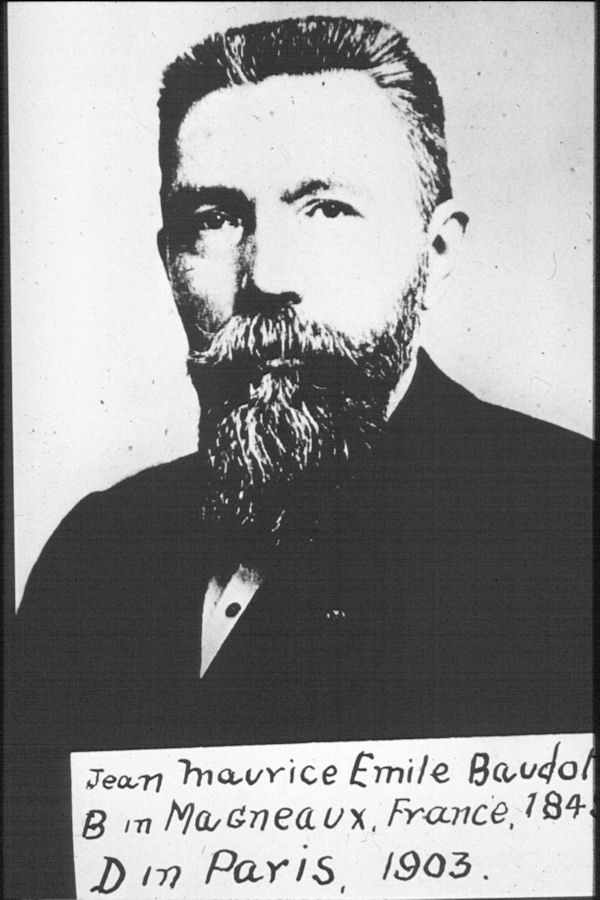
Emile Baudot
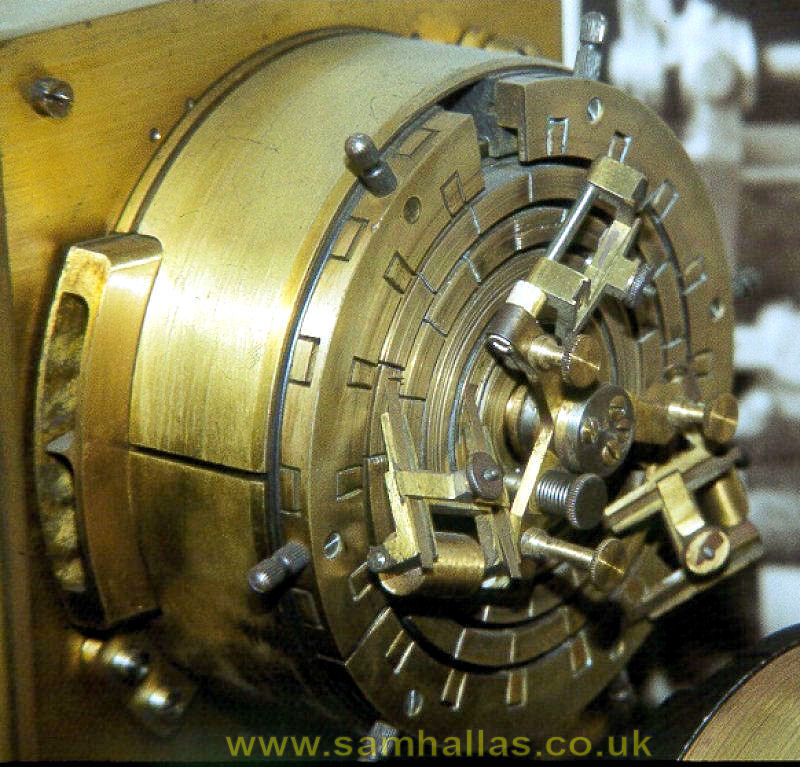
Baudot distributor
The Baudot printing telegraph was invented by Emile Baudot of the French telegraph service in 1874. Today it would be called a synchronous time division multiplex system. It used certain printing details from the Hughes instrument, a distributor invented by Bernard Meyer in 1871, and the five unit code devised by Gauss and Weber. Baudot combined these, together with original ideas of his own, to produce the final multiplex system. [Picture: BT archive]
The Baudot distributor is central to the operation of the system. Brushes rotate over the segments driven either by weights or an electric motor. The brushes connect several transmitters and receivers in turn to a single line. Typically four channels could share one line. Correcting currents were sent down the line to keep the brushes in synch at the two ends.
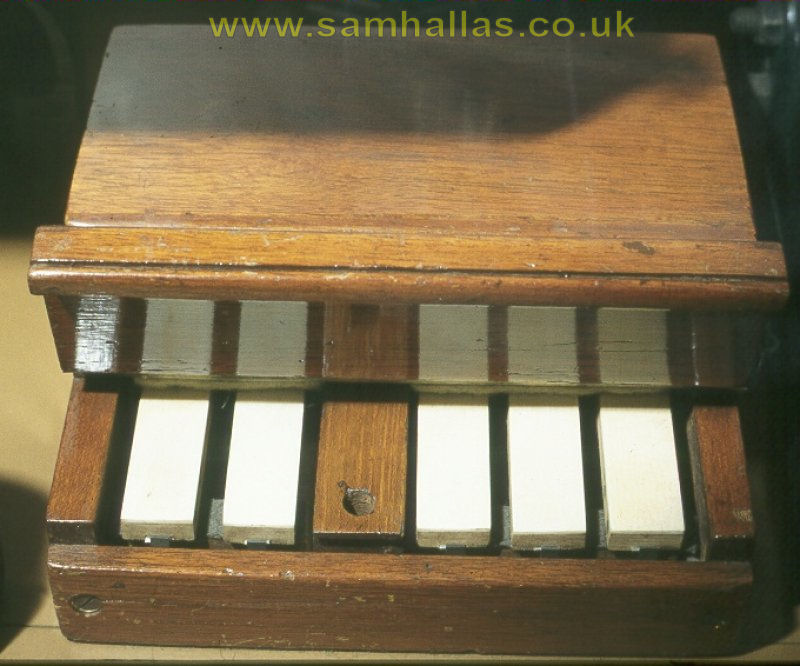
Baudot keyboard
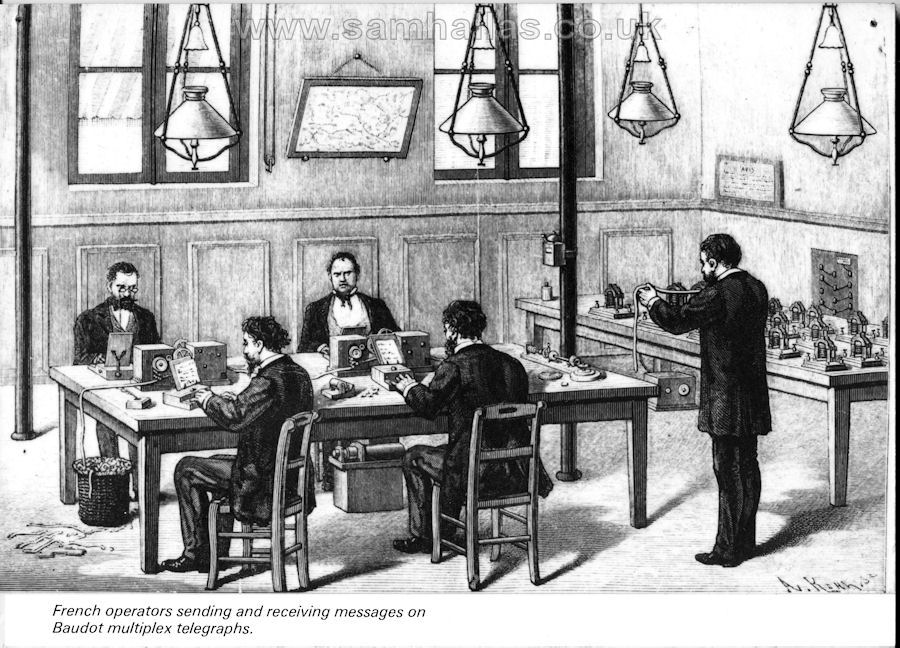
Baudot multiplex operators
There were five piano type keys, worked by two fingers of the left hand and three fingers of the right hand. The five unit code employed by the system was arranged to be easy to remember.
Once the keys have been pressed they are locked down until the brushes have passed over the segments connected to that keyboard. Remember that there may be four or more keyboards connected to one distributor. The keyboard is then unlocked ready for the next character with an audible click to warn the operator, known as the cadence signal. Working the Baudot keyboard required a lot of skill. The operator had to keep up a steady unvarying, rhythmic pace. The usual speed of operation being 180 letters per minute.
The receiver is also connected to the distributor. The signals from line are stored on a set of five electromagnets. The combination is then decoded to print the character on paper tape.
The Baudot system was accepted by the French administration in 1875. It saw widespread service in France and other countries and the British Post Office adopted it for a simplex circuit between London and Paris in 1897. [operators picture: Science Museum]
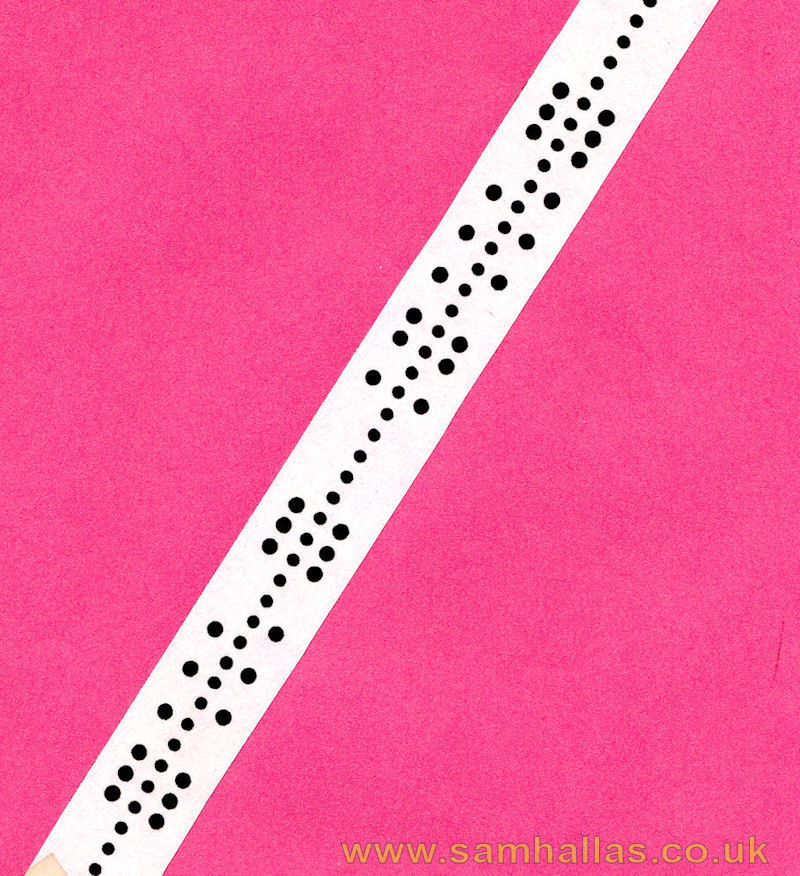
Morse tape
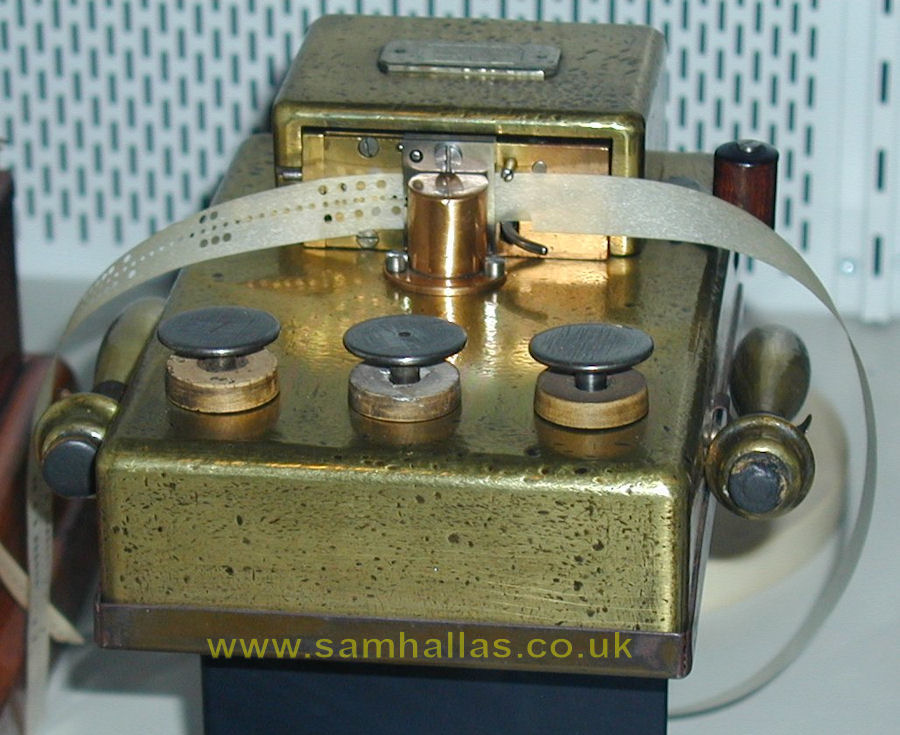
Stick punch
At this stage, telegraphy had reached a sort of halfway house. Reception was now automatic, but sending relied on an operator. Obviously a human operator is limited in both speed and accuracy. An operator might be able to transmit at a maximum speed for a short while, but they cannot keep up the pace without making mistakes. Even the fastest operator is usually slower than the maximum speed of the line. So on expensive lines - especially transatlantic lines - some sort of automatic transmission would be more economic.
The earliest practical system was invented by Wheatstone in 1867. First of all the message was punched by an operator into perforated tape. [The first group of characters on the tape read 'SOS' but the second group is 'EIOS' - whoops!]
The original Wheatstone perforator was entirely mechanical. There was a separate key for a dot, space and a dash. The keys were hit with rubber tipped mallets rather like playing a xylophone. This was called the Stick Punch. (Correction: I don't think Alan Hobbs had seen the sticks when he wrote that in 1987. Looking at the sticks it's evident that you hold them in your fist and smash them down on the buttons to punch the tape. Forget xylophones)
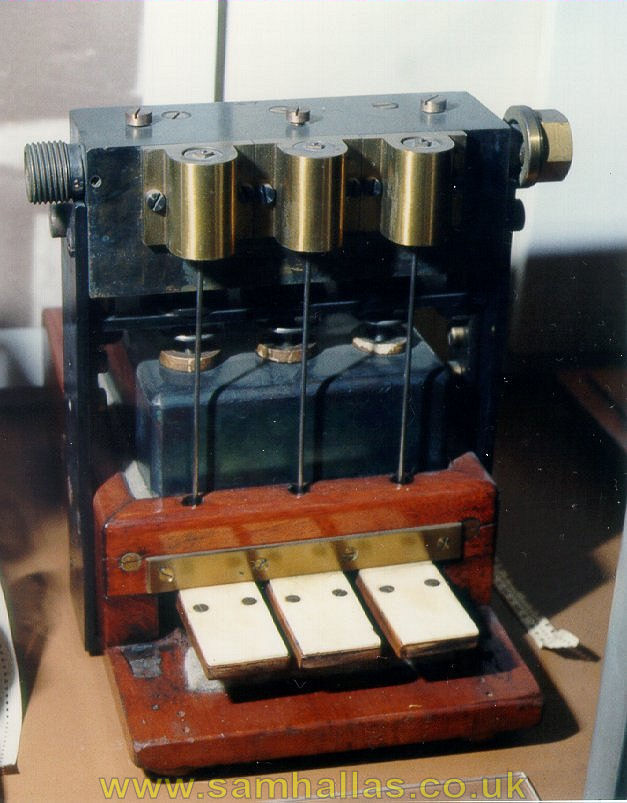
Pneumatic punch
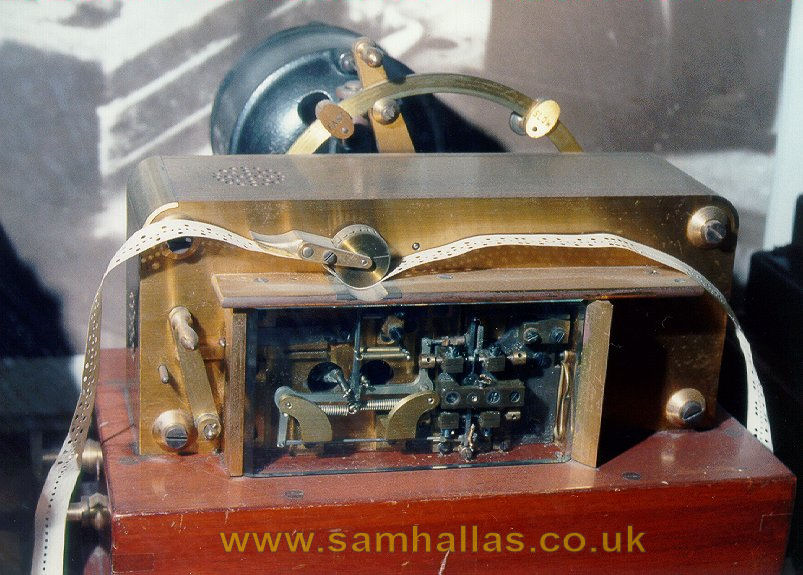
Morse tape transmitter
Later on, Wheatstone devised a punch with pneumatically operated punches. It could punch up to eight tapes at once. [Look closely and you'll see it looks like a stick punch inside a pneumatic drive frame] Later still, typewriter style keyboards were produced by a number of inventors. (Gell perforator shown below) The keyboard automatically produced the complete Morse code for each character, quicker and more accurately. With these later keyboards a touch typist could keep up an average of 40 words a minute, against 25 words a minute for a good punch operator.
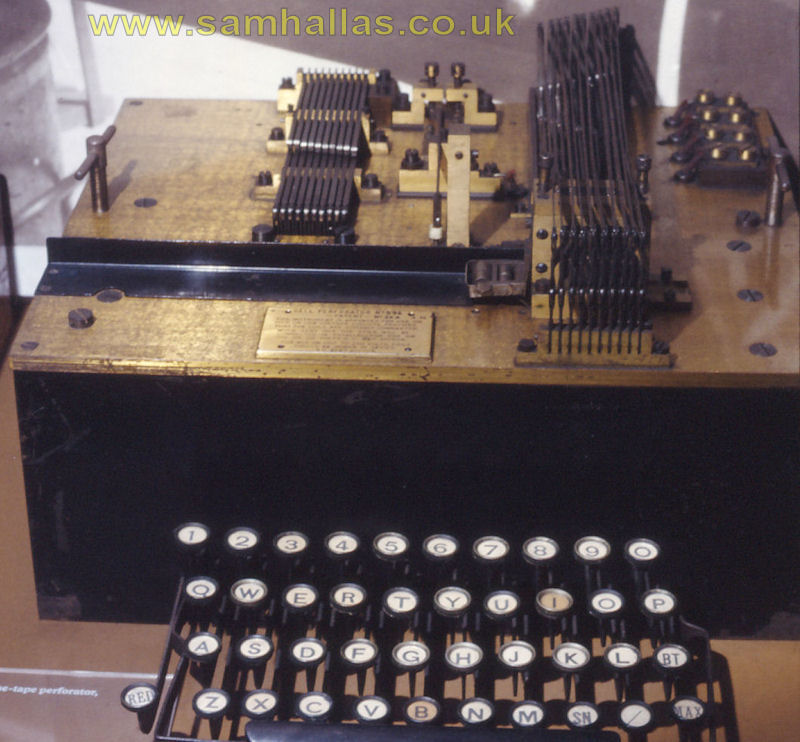
Gell perforator
Wheatstone’s transmitter took the perforated tape and by a combination of levers sent either a dot or a dash to line. A dash was arranged to be three times as long as a dot. Speed was typically 70 words a minute, which was much faster than any single operator could keep up for long. The receiver operated like the Morse inker we saw earlier and produced a record on paper tape to be read later.
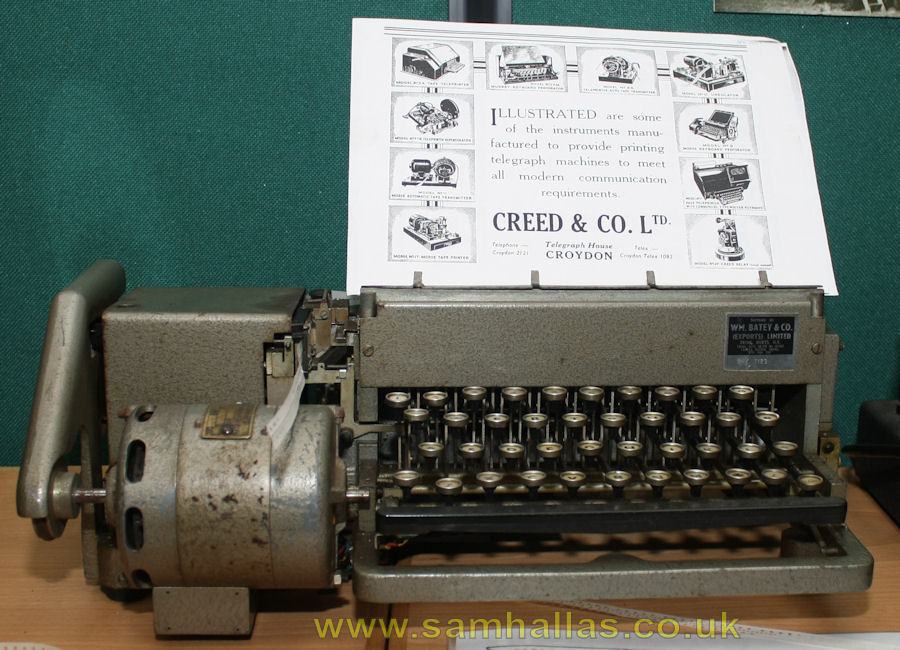
Creed Morse keyboard
In 1897 there was a young telegraph operator with the South American Telegraph and Cable Company in Chile. He decided that there had to be some better way of making perforated tape than playing a xylophone. Fired with enthusiasm, he threw up his job and set sail for Britain determined to put his ideas into practice. He started work in a garden shed in a suburb of Glasgow. With the aid of an old typewriter, bought for 15 shillings (75 pence) in the Sauchiehall Street market, his ideas began to take shape.
The young telegraph operator’s name was Frederick George Creed.
His machine was operated by compressed air and the first order for a quantity of 12 came from the British Post Office in 1902. Next, Creed produced a receiving perforator, what we now call a reperforator. From the received signal it produced a tape identical to the transmitting tape. Then he designed a printer that took the tape and printed plain characters on a paper tape.
And so the Creed high speed automatic printing telegraph was born. It could run at the astonishing speed of 200 words per minute.
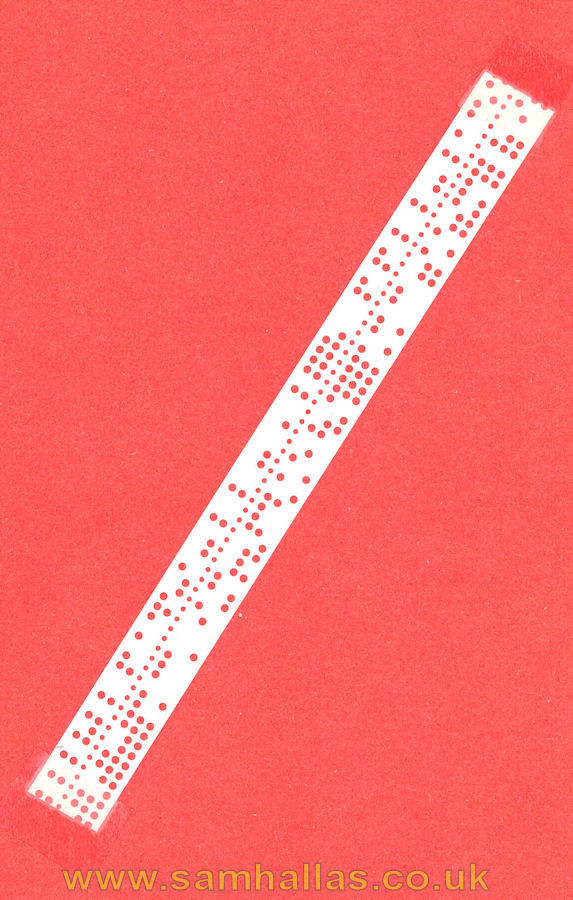
5-unit tape
At the same time the Baudot system was improved by switching to punched tape, prepared off-line like the Morse tape used with the Wheatstone and Creed systems. A tape reader, controlled by the Baudot distributor, replaced the manual keyboard. The tape had five rows of holes for the code, and a sixth row of smaller holes for feeding the tape through the reader. Baudot’s code, which you will remember was made to be easy to memorise, was later standardised as the International Telegraph Alphabet Number One.
[The tape, left, is in the modern Telex alphabet, ITA2, and reads (B.A.R.) 'T.G. HAS STEADILY GROWN UNTIL NOW IT HAS ABOUT 900 MEMBERS
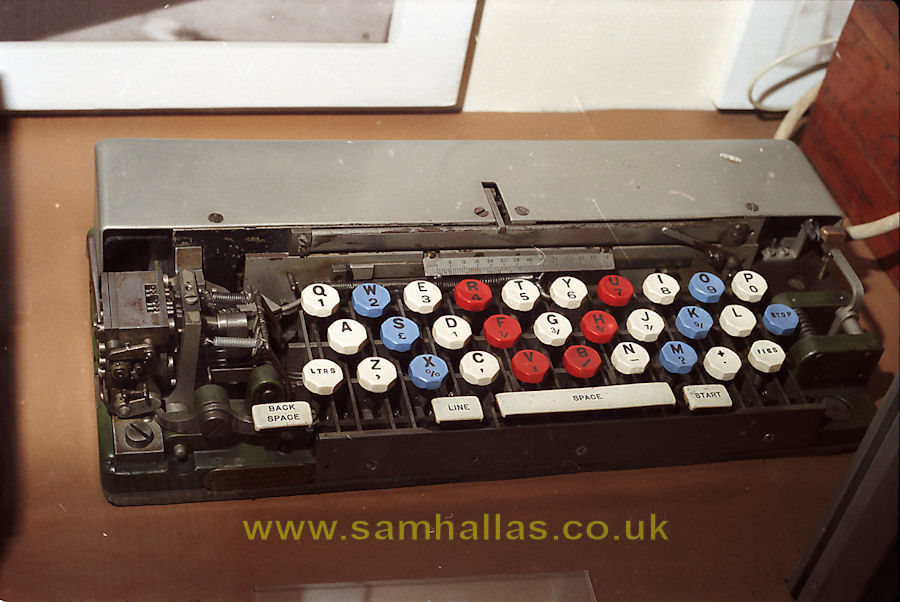
Murray keyboard & punch
In 1902 the New Zealander, Donald Murray, devised a combination of the best bits of the Baudot multiplex and his own automatic system. Murray also used a five unit code, but his great contribution was that he chose the combinations so that the most used characters needed the fewest mechanical movements of the works. This was important, and was significantly different from Baudot’s code, which you will recall was made to be easy to remember.
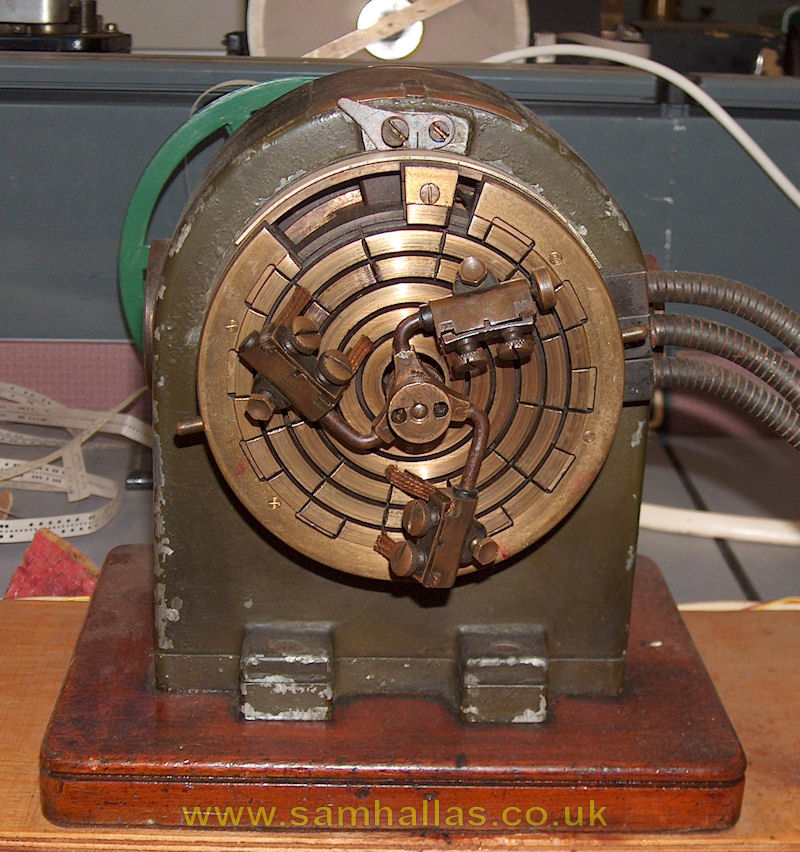
Murray phonic wheel
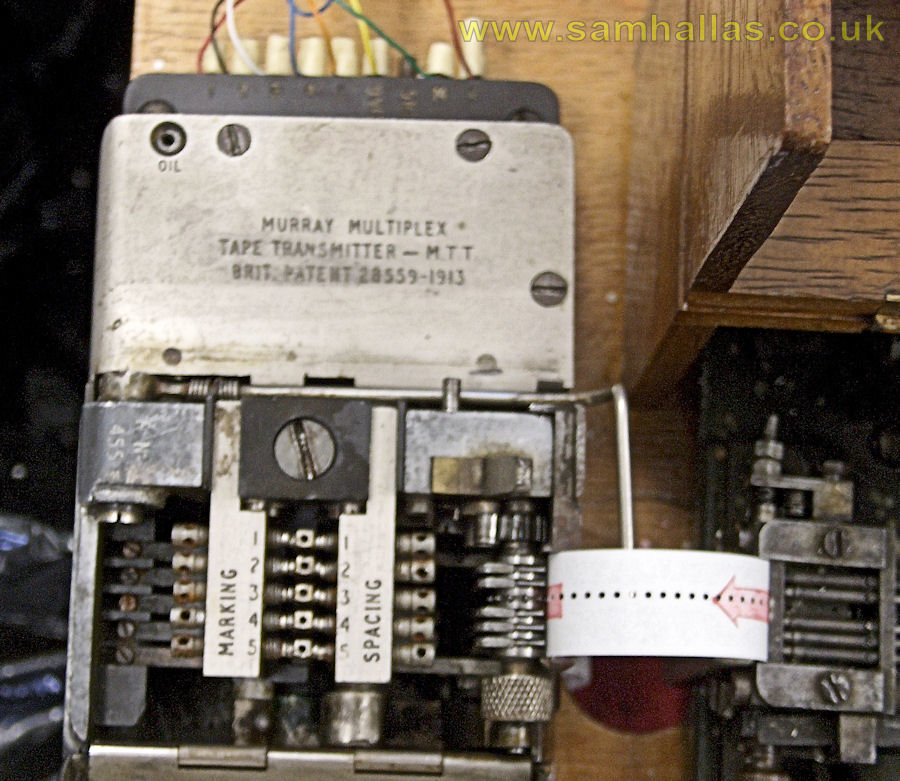
Murray tape reader
The Murray system was a multiplex telegraph and so it had a distributor similar to Baudot's. It was called a 'phonic wheel' (left) which was synchronised with the receiving wheel at the other end. Transmission was done from a paper tape punched off-line by the keyboard shown above right. The tape reader (right) was driven by the phonic wheel. Printing at the receiving end took place on a printer similar to the Morkrum model shown below. [Pictures from Telstra Museum, Brisbane, courtesy of Richard Youl]
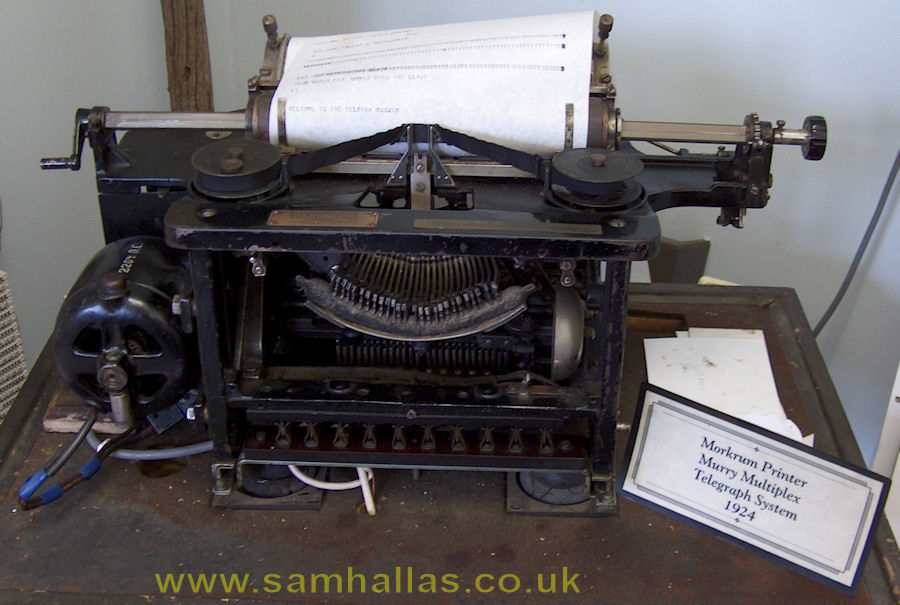
Morkrum printer
Murray’s code was never given any international recognition and, like the Baudot code, is no longer in use, although both their names are still remembered as pioneers of telegraphy. Watch some video footage of the Brisbane Museum system in action, courtesy of Richard Youl in the clip below.
Murray multiplex in action
These articles copyright 1987-2014, AG Hobbs & SM Hallas.
Back to Top